Monday, September 17, 2012

Klaus Nomi (1982)

Meet Klaus Nomi, an eccentric, flamboyant German opera singer who got his big break touring with David Bowie and decided to put out a record of New Wave music. Not weird enough? I should mention that he was a countertenor, meaning that he could sing at an extremely high pitch, and that the highlights of the album are bizarre covers of sixties girl-group pop songs.

This is one of those records that makes everyone who hears it scratch their head in confusion and when played for friends will inevitably elicit the response "what is this?" It's not an easy question to answer. As you can see from the image above, Nomi is not helping the stereotype that Germans are weird with his outlandish costumes and makeup job that looks like it came straight out of an F. W. Murnau film.

The instrumentation baking up Nomi's heavily accented voice is rather thin, consisting of angular guitars, some eighties synths, a little piano and the occasional smattering of backing vocals to evoke the sixties atmosphere of some of the covers. These include "Lightning Strikes," "You Don't Own Me" and "The Twist" all sung with the over the top melodrama only a campy opera singer can pull off (although whether he does, in fact, pull it off is purely a matter of opinion.

There are also some original compositions, which are decent and just as zany, but lack some of the surreal fun of lines like "You don't own me, don't say I can't play with other boys!" The album ends bizarrely with an excerpt of a legitimate operatic aria, which is fine but totally out of place.

Klaus Nomi went on to record one more studio album (featuring a cover of "Ding Dong The Witch Is Dead!" How great is that?) and a live record before sadly dying of AIDS in 1983. His debut is a fun listen for fans of novelty albums and general musical oddities.

Sunday, September 9, 2012

Chris Watson - El Tren Fantasma (2011)

Before television and before the internet, National Geographic made a lot of money by taking the trouble to photograph remote and exotic locales and bring those images right into people's homes. Most Americans would never have a chance to see such amazing sights in person, and so it was a real thrill to catch a glimpse of what the rest of the world looked like.

Now, that same experience can be had with such ease that it has lost much of its allure. With a click of a button, we can see pictures of any place in the whole world, but vision is only one of the senses, and people have a way of forgetting about the evocative power of sound.

That is why I love field recordings so much. Sure we know what most of the world looks like, but what does it sound like? Chris Watson, a founding member of the tremendously influential industrial group Cabaret Voltaire, wants to answer that question for us. With microphone in hand, he captures a staggaring array of ambient sounds from all variety of environments and packages them neatly for our enjoyment.

This particular release draws from recordings made of a now abandoned railway line in Mexico originally made for use in a documentary. Watson presents them here as the voyage of a "ghost train," a spooky remembrance of a trip that will never be taken again.

When it comes to editing field recordings, it can be tricky to strike the proper balance; too much and it loses its authenticity, too little and it risks being boring. Watson does a superb job of concealing his handiwork, and only on one track does he give into the temptation to craft a little rhythmic loop that actually sounds like music.

The rest of the recordings are both unified in spirit and diverse enough to hold the listener's interest. There is the repeated leitmotif of the train's rhythmic chugging along the tracks, a sound that would not be out of place on an early industrial record. There are quiet parts of serene atmospherics, and there are loud parts comprised of buzzing insects or other wildlife.

In short, Watson does everything right when it comes to taking real recordings of a real place and presenting them in a way that is coherent and digestible, not to mention entertaining. I look forward to hearing more of his work in the future.

Tuesday, August 7, 2012

Vangelis - Heaven and Hell (1975)


Vangelis is a Greek composer and multi-instrumentalist most famous for his score for the film Chariots of Fire. As surprising as it may seem, he actually has a long and productive career with many studio albums to his name. This is one of his most well known and celebrated, a collection of two side-long suites based on the concept of - you guessed it - Heaven and Hell.

This is a difficult album to review, because musically, it's all over the place. I'll be frank, there are a lot of cringe-worthy moments here. The use of the synthesizer was still relatively unrefined in 1975, but Vangelis dives in with gusto, producing sounds that now seem very badly dated. The first half of side one is bombastic and unpleasant, with annoyingly abrasive synths and hackneyed vocals by ominous sounding Greek choirs. This is supposed to be Heaven?

Side two, Hell, is, in general, much less prone to these sorts of problems and has plenty of lovely moments with tolling bells and a lovely female vocal melody, although the tasteful creepiness is still occasionally interrupted by obnoxiously dated sound effects, including an incredibly annoying siren-like synthesizer that won't shut up.

So why am I featuring this album when it seems to have so little going for it? Because Vangelis makes up for all of it, all of the tacky synths, the lack of restraint, the bombast, the hokey choirs, and the general vagueness of his concept in the second half of side one. He makes up for it, and then some.

About ten minutes in to the Heaven half, all the choirs and keyboard riffs drop out and a sense of cosmic peace washes over the listener. This section may be familiar to some as the theme from the Carl Sagan TV series, Cosmos. The music here is absolutely perfect, capturing the vastness and beauty of space, and then just when you think it can't get any better, it does.

The last section of the Heaven side is a song called "So Long Ago, So Clear" sung by Jon Anderson of the band Yes. It's utterly gorgeous, with Anderson in fine voice and the melody one of exquisite grace and tenderness. This section along with the previous one comprise roughly a quarter of the album, yet they are so good that they force to (almost) overlook the record's other flaws. Honestly, that ten minutes is worth the price of admission.

Maybe other listeners are less bothered by the synth parts (or less taken with Jon Anderson) than I am, but for me Heaven and Hell is a bewildering listen, a product of its time that leaves me feeling both moved and vaguely annoyed.

Saturday, July 14, 2012

Contortionist Jazz Exotica (2012)


Some noise artists have attempted to elevate the genre to a new level of sophistication and subtlety. Aube creates entire albums out of a single, sometimes surprising, source. Merzbow has theme albums that utilize bird songs and prog rock samples. In general, there has been a gradual development of noise music from anarchic racket to cultured sound manipulation.

Contortionist Jazz Exotica resists this evolution with every fiber of their being. The band refuse to provide any  information about themselves or their music, and the tape they sent me (not CD, tape! I had to go out and specifically acquire the hardware necessary to listen to it!) contains no track titles or any other text at all.

Don't let the name fool you. There is no jazz, much less exotica to be found here. It's a chaotic, sometimes terrifying listen that sounds like a wild, drug and alcohol fueled Saturday night gone horribly wrong. It's very, very noisy, with few identifiable sources for the sounds. There's a lot of feedback, much screaming and a few repeated loops. The only time the wall of sound breaks down is to make way for a few vocal samples that are no less incomprehensible and disturbing.

 It's kind of refreshing to hear modern experimental music stripped of the glitzy Pro-Tools trappings and bared down to pure DIY noisemaking. In a way I am reminded of early Einstürzende Neubauten or Foetus. Still, Contortionist Jazz Exotica is a harrowing, though never boring, experience. Fans of the underground noise scene will surely find much to appreciate about the band.

Monday, July 2, 2012

Liminal Phase - LP (2011)


This is the debut album from Liminal Phase, a sort of free form psychedelia ensemble recorded live in the studio with barely any preconceived ideas for composition. The result is an extremely diverse, sprawling set of tracks that traverse a wide range of influences and genres.

Despite having only six members, Liminal Phase really has the feel of an avant garde big band, perhaps due to their jazz-informed practice of structured improvisation with alternating solos, as well as the fact that every member plays several different instruments. However, jazz is only one of the many styles brought to bear here, with a good deal of inspiration being drawn from world music, such as Indian raga and Middle Eastern motifs.

A trippy vibe is maintained throughout, and one is put in mind of modern day jam bands like Ozric Tentacles only with a more varied sound, and improvisational collectives like Volcano the Bear only less weird. However, the album's greatest strength is also its weakness.

Because the material was edited down from several hours of jamming, there is a certain discontinuity that is noticeable as some of the tracks don't flow into each other as well as they might. Still, for those who relish the wild side of free-form psychedlia, there is much to enjoy here.

The "songs," all of which are instrumental, range from under two minutes to over thirteen in length, and there is sure to be something for everyone. Personally, I prefer the long, drawn out pieces where themes really have a chance to develop into something special, but sometimes a bite sized chunk of weirdness is just what the doctor ordered. It will be a pleasure to watch how this fledgling group develops over the next few years and I will certainly be curious to see what their next release brings.

Friday, June 15, 2012

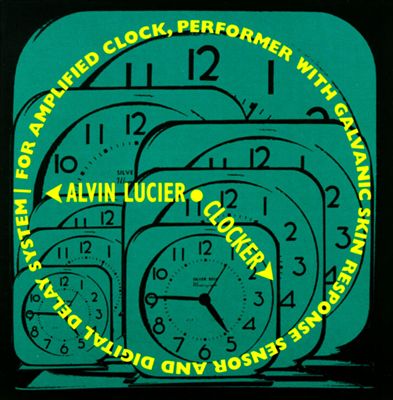
Alvin Lucier - Clocker (1994)


Alvin Lucier's music frequently straddles the line between entertainment and science experiment, and sometimes the actual audible results are overshadowed by the acoustic concepts he is so intent on demonstrating. Whether or not that is the case here, each listener will have to decide for himself, but I personally find Clocker to be a rewarding, if fairly infrequent, listen.

The forty-five minute piece is an attempt to simulate the speeding up and slowing down of time, a highly abstract and ambitious goal to be sure. To achieve this, Lucier has affixed several galvanic skin response sensors to his body, and has rigged a clock to respond to the resulting signals, complete with a delay effect to make it sound cooler. And that's all there is, a ticking clock that changes its speed in response the resistance of the composer's skin. Sound boring? It's actually pretty cool.

As the clock changes speeds, the pitch of the clicks changes as well, so the fast bits are high and fluttery, while the slow bits are deep and ominous. You can also hear the overtones quite nicely, and dramatic sweeps create a kind of watery splooshing effect.

It could be argued that the whole thing goes on a little long, but there is surprising variety to be found. The presense of delay allows for some interesting interlocking rhythms, and there is a delightfully suspenseful moment when the ticking becomes too high and fast to hear and the resulting dramatic pause hangs in the air for just the right amount of time before the clock comes plunging back into the realm of audible frequencies.

Clocker is a high concept piece to be sure, and not for everyone, but for those interested in pursuing the frontiers of sonic possibilities, it can be a pretty neat trip.

Thursday, June 7, 2012

Edgar Froese - Aqua (1974)

 
Fans of Tangerine Dream who have neglected group leader Edgar Froese's solo output are really missing out on something special. Specifically, they're missing out on what are basically more Tangerine Dream albums from their most respected period!

Aqua is Froese's first solo outing, released the same year as the celebrated Phaedra, and in my view every bit as good. It contains the same sequencer driven analog synth soundscapes that became the group's trademark, as well as a few slightly more experimental touches here and there.

While the sound is similar to Phaedra in many ways, Aqua nevertheless feels like its own record, with a tone that is if anything more unified than that of its sister album. The title suggests that we're in for a watery experience, and to a certain extent that's true. The title track is basically seventeen minutes of bubbling noises with slow synth melodies layered underneath. However, on the whole I think the album sounds more airy than liquid, with a sort of high, thinness that puts one in mind of jet engines.

Indeed, the second side of the record opens with a jet engine kicking off the track NGC 891. It was on this track that Froese attempted some (not entirely successful) experiments with early surround sound. It is a very spacey track and in my opinion the more enjoyable of the two long pieces on display here.

Another track, Panorphelia, conjures up images of touring the beautiful countryside in a hovercraft, while the album ends on a slightly spooky Hammond organ workout called Upland. The record as a whole seems to me very positive and future-centric, focused on flight and exploration. It's lighter in mood than the concurrent TG releases, and reminds me of that 1950s brand of science fiction filled with unbridled optimism at the joy of new technology.

Froese seems to be reveling in that joy as he discovers the possibilities associated with synthesizers, and is having great fun making music of the future. A thoroughly enjoyable slice of vintage electronica.