Showing posts with label Minimalism. Show all posts

Friday, June 15, 2012

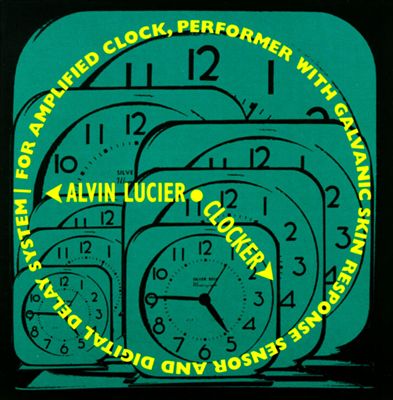
Alvin Lucier - Clocker (1994)


Alvin Lucier's music frequently straddles the line between entertainment and science experiment, and sometimes the actual audible results are overshadowed by the acoustic concepts he is so intent on demonstrating. Whether or not that is the case here, each listener will have to decide for himself, but I personally find Clocker to be a rewarding, if fairly infrequent, listen.

The forty-five minute piece is an attempt to simulate the speeding up and slowing down of time, a highly abstract and ambitious goal to be sure. To achieve this, Lucier has affixed several galvanic skin response sensors to his body, and has rigged a clock to respond to the resulting signals, complete with a delay effect to make it sound cooler. And that's all there is, a ticking clock that changes its speed in response the resistance of the composer's skin. Sound boring? It's actually pretty cool.

As the clock changes speeds, the pitch of the clicks changes as well, so the fast bits are high and fluttery, while the slow bits are deep and ominous. You can also hear the overtones quite nicely, and dramatic sweeps create a kind of watery splooshing effect.

It could be argued that the whole thing goes on a little long, but there is surprising variety to be found. The presense of delay allows for some interesting interlocking rhythms, and there is a delightfully suspenseful moment when the ticking becomes too high and fast to hear and the resulting dramatic pause hangs in the air for just the right amount of time before the clock comes plunging back into the realm of audible frequencies.

Clocker is a high concept piece to be sure, and not for everyone, but for those interested in pursuing the frontiers of sonic possibilities, it can be a pretty neat trip.

Sunday, January 2, 2011

Philip Glass - Music With Changing Parts (1971)


Philip Glass is the man most people immediately think of when they hear the term "minimalist music," and while he was neither the first nor the most minimal of this school of composers, he was the most commercially successful and to the victor go the spoils. In recent years, he has been halfheartedly tossing off film scores while presumably rolling around in his piles of money, but back in the seventies he created some truly innovative and amazing music.

"Music With Changing Parts" is probably my favorite Glass piece from this period. It's an hour long, semi-improvisatory composition for his usual ensemble of woodwinds and keyboard instruments. It has since been dismissed by the composer as "too spacy" but personally, I think it's just spacy enough. It begins with a repetitive figure on a lone electric organ which is then quickly joined by other instruments. What I like about this piece is that it evolves so slowly that unless you are paying very close attention, you will not even notice that anything is changing. If you exerpt any given thrity seconds from the piece, it will sound like the same phrase repeared over and over again, but at the end of five or ten minutes, the music will sound nothing like it did in the beginning.

Although there is constant motion througout its length, the repetition gives the piece a drone like quality and it's easy to be swept away by it. Fans of psychedelia will probably find much to enjoy here. Indeed, the motion of Glass's music is not unlike that of a lava lamp.

The concepts explored here would be further developed on the marathon three-disc set of "Music in Twelve Parts," the principle difference being that that work is divided into twelve distinct sections of approximately twenty minutes each whereas this maintains its continuity for over an hour. Both are essential additions to any collection of minimalist music.

Monday, August 23, 2010

Terry Riley - Shri Camel (1980)


The New York Minimalist scene is often summed up in the trifecta of three popular composers, Philip Glass, Steve Reich and Terry Riley. Of the three, Riley has arguably been the most overtly experimental in his compositions, with groundbreaking pieces like "In C" and his pioneering use of tape delays to create overdubs in live performances. His music also tends to contain an element of spirituality, and like the old hippy that he is, he has not neglected the world of Eastern mysticism.

Shri Camel is Riley's exploration of the techniques he learned from years of studying Indian ragas. Indeed, his music has often been lauded as ideal for use in meditation. However, he has incorporated these techniques into his own style of composition and the music does not, in itself, sound particularly Indian. There are no sitars or tablas present, yet the complexity and form of the raga is present throughout and the pieces are at times extremely involved, with up to sixteen lines of counterpoint happening at once.

The album consists of four lengthy pieces, each performed live in the studio by Riley on a Yamaha organ, resulting in a musical palette that is somewhat monochromatic. Riley uses a similar technique to that which Brian Eno and Robert Fripp put to great use in the seventies, looping his performance and adding parts on top of it in real time. If done recklessly, this can result in aural chaos that is impossibly to make sense of, but Riley has been practicing the method for decades and takes care to maintain transparency across the various lines. He also differentiates the parts by changing the settings on his organ, altering timbres and percussiveness so that the listener can distinguish his phrasing. This gives the music more depth and color, wile still maintaining a unity of sound across all four pieces.

The other unique aspect of Shri Camel is the fact that Riley has tuned his instrument using the "Just Intonation" system which, in contrast to the equal temperament tuning used in 99.9% of Western Music, follows more closely the physical overtone series found in nature. The difference, in terms of sound, is that "Just Intonation" sounds slightly alien to the practiced ears of a modern Westerner. It strikes us as ever so slightly "off." This can be disconcerting at first, but once you are able to let go of your preconceived notions about tuning and appreciate sound for sound's sake, it comes as a welcome relief from the sameness of the music we hear every day.

Shri Camel is a wonderful example of what Riley does best, and while it may prove difficult listening to the average person due to its unusual tuning system and reliance on a single keyboard instrument for its entire duration, it will reward those with patience by providing them with a gentle beauty not eaily found in the music of today.

Friday, May 8, 2009

Alvin Lucier - I Am Sitting In A Room (1970)


Alvin Lucier is a composer who has always straddled the precarious line between art and science. His works usually consist of practical demonstrations of physical phenomena, and yet they always provide a fascinating, surprisingly musical listening experience.

In "I Am Sitting In A Room," the composer reads a short speech, then plays the tape back into the same room and rerecords it. This process is repeated over and over again, with the result that the sound quality gradually decays and the frequencies that are naturally amplified by the physical space are the only things that remain. In this way, Lucier is effectively "playing" the room, and the results would be different for any given enclosed space.

The performance on this disc lasts about forty-five minutes. At about the fifteen minute mark, most of the actual words are unintelligible, and the speech has taken on a somewhat melodic, almost bell-like sound. Lucier has a slight stutter, and it is interesting to hear how this factors into the sounds we ultimately end up hearing. For example, a stuttered "S" sound persists much longer than most of the other consonants, because of its fundamental lack of pitch. So even towards the end of the piece we are able to hear the occasional "s- s- sss" which then becomes something of a rhythmic figure.

The simplicity of the concept and ease of execution make "I Am Sitting In A Room" a fascinating classic of electro-acoustic music, not to mention its hypnotic qualities for the listener. This is something that could be reproduced by any of us at home, and remember that it need not be with a voice. Similar results could be achieved with an instrument, a band, a portion of a movie soundtrack or really anything that makes a sound. Try it for yourself and see!