Saturday, July 14, 2012

Contortionist Jazz Exotica (2012)


Some noise artists have attempted to elevate the genre to a new level of sophistication and subtlety. Aube creates entire albums out of a single, sometimes surprising, source. Merzbow has theme albums that utilize bird songs and prog rock samples. In general, there has been a gradual development of noise music from anarchic racket to cultured sound manipulation.

Contortionist Jazz Exotica resists this evolution with every fiber of their being. The band refuse to provide any  information about themselves or their music, and the tape they sent me (not CD, tape! I had to go out and specifically acquire the hardware necessary to listen to it!) contains no track titles or any other text at all.

Don't let the name fool you. There is no jazz, much less exotica to be found here. It's a chaotic, sometimes terrifying listen that sounds like a wild, drug and alcohol fueled Saturday night gone horribly wrong. It's very, very noisy, with few identifiable sources for the sounds. There's a lot of feedback, much screaming and a few repeated loops. The only time the wall of sound breaks down is to make way for a few vocal samples that are no less incomprehensible and disturbing.

 It's kind of refreshing to hear modern experimental music stripped of the glitzy Pro-Tools trappings and bared down to pure DIY noisemaking. In a way I am reminded of early Einstürzende Neubauten or Foetus. Still, Contortionist Jazz Exotica is a harrowing, though never boring, experience. Fans of the underground noise scene will surely find much to appreciate about the band.

Monday, July 2, 2012

Liminal Phase - LP (2011)


This is the debut album from Liminal Phase, a sort of free form psychedelia ensemble recorded live in the studio with barely any preconceived ideas for composition. The result is an extremely diverse, sprawling set of tracks that traverse a wide range of influences and genres.

Despite having only six members, Liminal Phase really has the feel of an avant garde big band, perhaps due to their jazz-informed practice of structured improvisation with alternating solos, as well as the fact that every member plays several different instruments. However, jazz is only one of the many styles brought to bear here, with a good deal of inspiration being drawn from world music, such as Indian raga and Middle Eastern motifs.

A trippy vibe is maintained throughout, and one is put in mind of modern day jam bands like Ozric Tentacles only with a more varied sound, and improvisational collectives like Volcano the Bear only less weird. However, the album's greatest strength is also its weakness.

Because the material was edited down from several hours of jamming, there is a certain discontinuity that is noticeable as some of the tracks don't flow into each other as well as they might. Still, for those who relish the wild side of free-form psychedlia, there is much to enjoy here.

The "songs," all of which are instrumental, range from under two minutes to over thirteen in length, and there is sure to be something for everyone. Personally, I prefer the long, drawn out pieces where themes really have a chance to develop into something special, but sometimes a bite sized chunk of weirdness is just what the doctor ordered. It will be a pleasure to watch how this fledgling group develops over the next few years and I will certainly be curious to see what their next release brings.

Friday, June 15, 2012

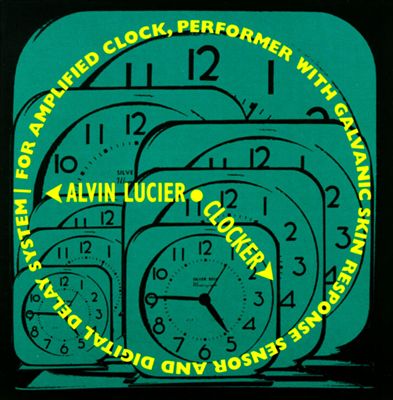
Alvin Lucier - Clocker (1994)


Alvin Lucier's music frequently straddles the line between entertainment and science experiment, and sometimes the actual audible results are overshadowed by the acoustic concepts he is so intent on demonstrating. Whether or not that is the case here, each listener will have to decide for himself, but I personally find Clocker to be a rewarding, if fairly infrequent, listen.

The forty-five minute piece is an attempt to simulate the speeding up and slowing down of time, a highly abstract and ambitious goal to be sure. To achieve this, Lucier has affixed several galvanic skin response sensors to his body, and has rigged a clock to respond to the resulting signals, complete with a delay effect to make it sound cooler. And that's all there is, a ticking clock that changes its speed in response the resistance of the composer's skin. Sound boring? It's actually pretty cool.

As the clock changes speeds, the pitch of the clicks changes as well, so the fast bits are high and fluttery, while the slow bits are deep and ominous. You can also hear the overtones quite nicely, and dramatic sweeps create a kind of watery splooshing effect.

It could be argued that the whole thing goes on a little long, but there is surprising variety to be found. The presense of delay allows for some interesting interlocking rhythms, and there is a delightfully suspenseful moment when the ticking becomes too high and fast to hear and the resulting dramatic pause hangs in the air for just the right amount of time before the clock comes plunging back into the realm of audible frequencies.

Clocker is a high concept piece to be sure, and not for everyone, but for those interested in pursuing the frontiers of sonic possibilities, it can be a pretty neat trip.

Thursday, June 7, 2012

Edgar Froese - Aqua (1974)

 
Fans of Tangerine Dream who have neglected group leader Edgar Froese's solo output are really missing out on something special. Specifically, they're missing out on what are basically more Tangerine Dream albums from their most respected period!

Aqua is Froese's first solo outing, released the same year as the celebrated Phaedra, and in my view every bit as good. It contains the same sequencer driven analog synth soundscapes that became the group's trademark, as well as a few slightly more experimental touches here and there.

While the sound is similar to Phaedra in many ways, Aqua nevertheless feels like its own record, with a tone that is if anything more unified than that of its sister album. The title suggests that we're in for a watery experience, and to a certain extent that's true. The title track is basically seventeen minutes of bubbling noises with slow synth melodies layered underneath. However, on the whole I think the album sounds more airy than liquid, with a sort of high, thinness that puts one in mind of jet engines.

Indeed, the second side of the record opens with a jet engine kicking off the track NGC 891. It was on this track that Froese attempted some (not entirely successful) experiments with early surround sound. It is a very spacey track and in my opinion the more enjoyable of the two long pieces on display here.

Another track, Panorphelia, conjures up images of touring the beautiful countryside in a hovercraft, while the album ends on a slightly spooky Hammond organ workout called Upland. The record as a whole seems to me very positive and future-centric, focused on flight and exploration. It's lighter in mood than the concurrent TG releases, and reminds me of that 1950s brand of science fiction filled with unbridled optimism at the joy of new technology.

Froese seems to be reveling in that joy as he discovers the possibilities associated with synthesizers, and is having great fun making music of the future. A thoroughly enjoyable slice of vintage electronica.

Wednesday, June 6, 2012

Perez Prado & Shorty Rogers - Voodoo Suite (1955)

Well, it's been a long time, but I noticed that I reached 10,000 hits in my absence, so I felt it was a good time to return to reviewing. Thank you for continuing to read!

Let's start with a rather strange and ambitious piece of afro-cuban/latin jazz/exotica by Perez Prado, the mambo king. The titular Voodoo Suite is a side long, kaleidoscopic trip through the various jazz styles of the ages. If that sounds like a crazy idea, it is, especially for 1955.

The record starts out slow and ominous with very primitive, tribal drums. They are almost arhythmic, and presumably meant to conjure up images of cavemen pounding away somewhere in Africa at the dawn of civilization. Gradually, low key chanting fades in adding an air of mysticism to the proceedings. After a few minutes this breaks off suddenly for some of Prado's trademark shouting at his band members.

When he's done, the full band comes back in, this time adopting a more traditional Latin sound, and for a while it becomes almost danceable. This builds in intensity, developing themes and adding instruments until it finally bursts into a sudden explosion of bebop, with Shorty Rogers wailing away on his trumpet, totally in his element. It doesn't sound anything like what you'd expect from a guy like Prado, but it works.

After that, things slow down and the piece starts to live up to its title, rocking back and forth to swampy and sinister grooves. Then it's back to classic Prado style mambo for a while before transforming into a driving drum circle pattern with alternating solos. Themes are revisited and more styles are explored until it gets tough to keep track of them. The whole thing is a masterpiece of arrangement, whatever you think of the composition, and it's clearly something Prado put a lot of love into.

he second side is filled with Latin big band covers of jazz standards, exquisitely arranged and performed, but ultimately overshadowed by the jungle themed tour de force that precedes them. All in all, the Voodoo Suite is a daring, at times abrasive, at times beautiful achievement. Those curious about the more eccentric side of Latin jazz would do well to check it out.

Monday, October 17, 2011

Power of Zeus - The Gospel According to Zeus (1970)

 
Power of Zeus were a hard rock/psychedelic group that had the misfortune to get signed to a Motown subsidiary. The folks at the label really had no experience with this kind of music, and the result of their efforts packs less of a punch than it might. The band members have expressed dissatisfaction with the album, claiming that it did not capture their live sound and, regrettably, they never got another chance.

Before writing them off as a footnote to the psychedelic movement, however, we have to admit that many of the songs presented here are quite good. The band had a lot of unique ideas, solid musicianship and the charm that only a Hammond Organ can bring. A couple of the tracks teeter on the edge of the then burgeoning progressive rock movement, while simultaneously delivering quite a trip to those inclined to such things.

The albums highlight is, at least for me, the seven and a half minute "The Death Trip" which, as the title implies, chronicles a man's journey into the afterlife. Apart from being spooky as all get out, it also rocks really hard. The climax has the singer screaming "I see the light!" over swirling and majestic Hammond chords, and is sure to get your adrenaline pumping. The closing track, "The Sorcerer of Isis," is similarly dark, although not quite as intense, with Eastern influenced guitar lines and mystical lyrics. The band's singer cites it as best capturing their live sound. "In The Night" is a personal favorite, and although a pretty straightforward rock song, it touches on the Devil and things that go bump in the night in a very satisfying way.

The rest of the album is filled out by capable, if somewhat mainstream, hard rock and the obligatory flower power hippy lovefest "Green Grass and Clover." While not a masterpiece, this album is a solid slab of seventies hard rock/psychedelia, and ranks a good deal higher in my book than Iron Butterfly's debut. It is sure to please fans of Uriah Heep, Deep Purple and Atomic Rooster.

Sunday, October 16, 2011

Luc Ferrari - Son Memorise (2006)


Luc Ferrari is something of a legendary figure in the strnage world of Musique Concrete/sound collage. Few composers have devoted so much time and effort to creating sounds which 99% of the population would not consider to be actual music. Thankfully for the other 1%, however, he remained an unstoppable force of unique and interesting composition for half a century, right up until his death in 2005.

Like John Cage before him, Ferrari was able to hear the beauty in everyday environmental sounds, and this posthumous album puts this quality on display wonderfully. Here we are treated to three long pieces. The first of these is a continuation of Ferrari's "Presque Rien" series, in which environmental sounds are edited down and assembled in such a way as to almost form a loose narratives. Conversation snatches in French and Italian, animal noises and ambient sound blend together with the occasional rhythmic pattern to make a fascinating pastiche. Most of the time the edits are barely noticeable, but occasionally you can pick out repetitions and carefully constructed patterns indicative of the care taken by the composer.

The second piece is similar in nature, but longer and for me more engaging. It consists of a half hour of Ferrari strolling through a small town in Algeria, and the sheer variety of sound he captures is staggering. Bells, roosters, donkeys, locals singing, gun shots and many other exotic and beautiful noises forma rich tapestry of sound. This piece dates all the way back to 1978, but to me it sounds just as fresh and modern as anything else here. The final work abandons field recordings in favor of a more traditional example of Musique Concrete. It is well thought out and well constructed, but personally I prefer the field recordings for their magical ability to transport the listener to another time and place.

The only problem I have with this release is the bizarre approach to track indexing, in which each composition is broken up into seemingly arbitrary sections, but that's a very minor complaint given the quality of the music itself. Luc Ferrari is a definite must for those interested in electro-acoustic music, field recordings or Musique Concrete. And while the uninitiated will likely dismiss it is "just noise," those with an open mind and vivid imagination will find music like this refreshingly unique and beautifully evocative.